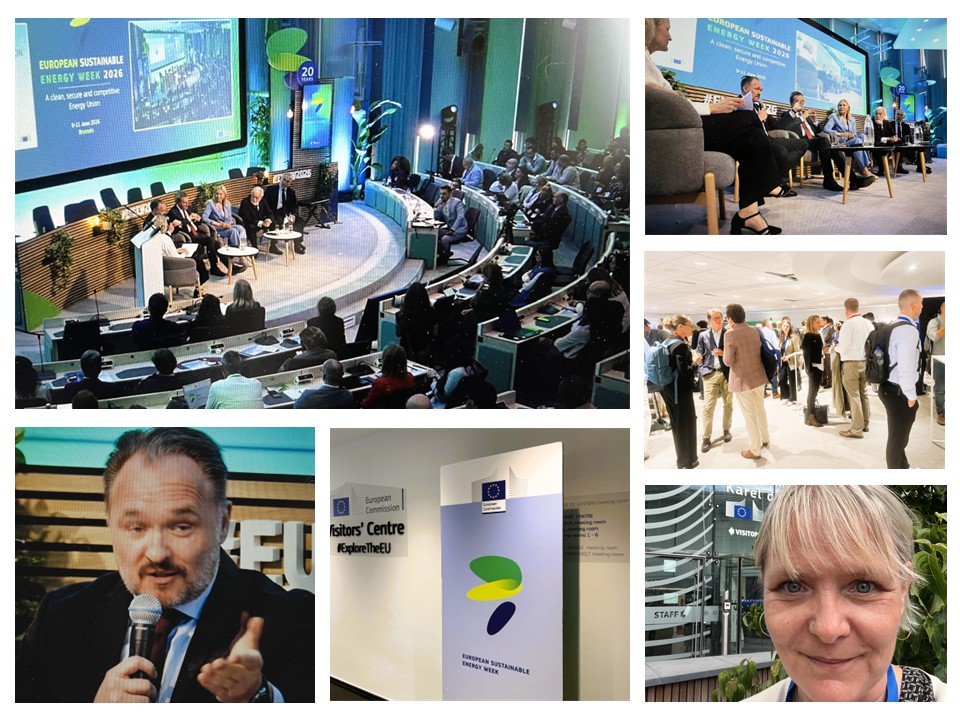
EUSEW 2026 – my reflection on three inspiring and motivating days in Brussels and online. I would like to extend my sincere thanks to CINEA—the European Climate, Infrastructure, and Environment Executive Agency—for the highly successful, interdisciplinary, inspiring, cross-sectoral, and motivating conference, which brought together thousands of participants from across Europe and beyond in Brussels and online to exchange ideas, share experiences, and discuss how to build a clean, secure, and competitive Energy Union. 50 panel discussions, along with the speakers, participants, and exhibitors, shaped this year’s event.
It was once again a great honor and pleasure for me to serve as one of the digital ambassadors for European Sustainable Energy Week.
The strong commitment shown by the Young Energy Ambassadors was particularly impressive this year.
The 20th edition of European Sustainable Energy Week (EUSEW) kicked off last Tuesday in Brussels and online (June 9–11, 2026) under the overarching theme “A Clean, Secure, and Competitive Energy Union.” The European Climate, Infrastructure and Environment Executive Agency (CINEA) organizes the European Sustainable Energy Week, the EU’s flagship event for clean energy and renewable energy.
🎯 Political Conference
🤝 Energy Fair
🏅 Awards Ceremony
💪 European Youth and Energy Day
I had been looking forward to this session in particular for several days: “Powering Change: 20 Years of European Clean Energy Transition,” and I was not disappointed. The fireside chat brought together former EU Commissioners Andris Piebalgs, Günther Oettinger, Miguel Arias Cañete, and Kadri Simson gathered for a fireside chat to discuss, together with current Commissioner Dan Jørgensen, how the continent’s priorities have evolved and what needs to be done next in light of a changing geopolitical and economic landscape.
Dan Jørgensen made the current goal crystal clear: 100% renewable energy!
The Clean Industrial Deal and the Affordable Energy Action Plan have already introduced a key performance indicator for the share of electricity in final energy consumption for all member states, setting a 32% target as a benchmark by 2030, and announced the Action Plan for Electrification. Scheduled for July 2026, this plan aims to accelerate the cost-effective and system-friendly electrification of EU energy consumption in transportation, industry, and buildings, accompanied by continued investment in clean energy and flexibility. https://energy.ec.europa.eu/topics/eus-energy-system/electrification_en
https://energy.ec.europa.eu/strategy/affordable-energy_en
https://commission.europa.eu/topics/competitiveness/clean-industrial-deal_en
Blog
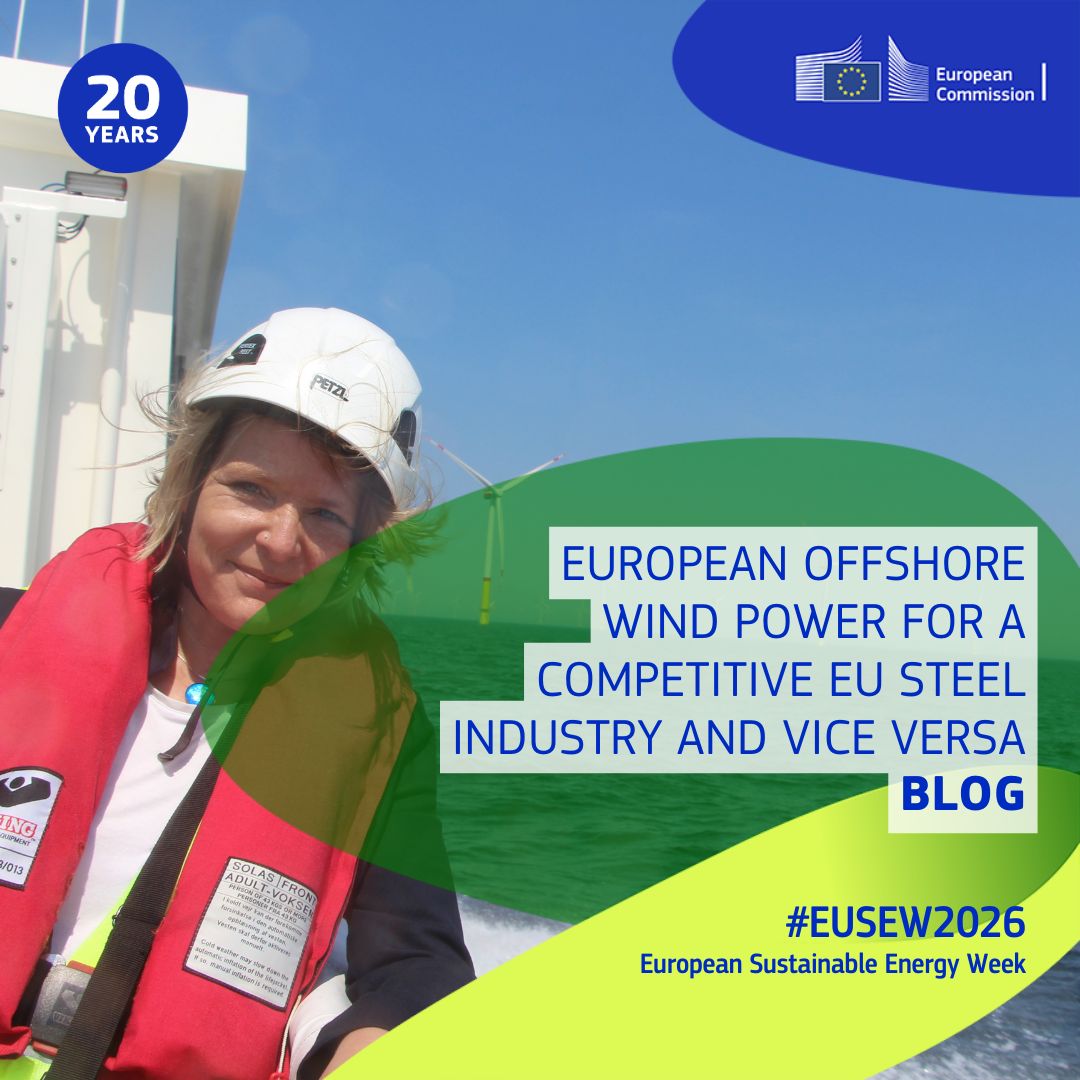
As one of the digital ambassadors, I not only had the pleasure of participating in EUSEW 2026, but also the great pleasure of publishing a blog post in which I explore the connection between green steel and offshore wind energy. Both industries are crucial for a climate-friendly future characterized by growing prosperity and job growth in Europe: “European offshore wind power for a competitive EU steel industry and vice versa” appeared in 23 publications in Greece, France, Switzerland, Belgium, the Baltic States, Central and Eastern Europe, and internationally https://sustainable-energy-week.ec.europa.eu/news/european-offshore-wind-power-competitive-eu-steel-industry-and-vice-versa-2026-02-10_en
Here in Germany, Brussels seems far away. 👣 As a European who has been working in the offshore wind industry for 18 years, I was very happy to be one step closer to the European agenda: Green Deal, NZIA, electricity market reform, Made in Europe, AccelerateEU, the Action Plan for Affordable Energy, the Clean Industrial Deal, CRMA, CISAF, CBAM, and much more. – Current energy policy developments in Germany seem largely unaffected by all these EU initiatives, as shown by the ongoing discussions on the reform of the Renewable Energy Sources Act (EEG), the amendment of the Offshore Wind Act, and many other current German regulatory initiatives. I remain hopeful and believe in the transition to a prosperous Europe, including in Germany.
Energ’ Ethic Podcast
In my view, the task now is to work together across Europe and beyond national borders to further break down the remaining barriers, so that not only the #greenleadmarket I described in my blog can really take off 🛫. This is the best way to ensure that a resilient, climate-friendly reindustrialization and energy supply creates more jobs and strengthens the competitiveness that Europe so desperately needs. – I was also able to address these and other thoughts on Marine Cornelis’ brilliant Energ’ Ethic podcast. Marine is also a Digital Ambassador, and with the support of CINEA, we were able to join two other Digital Ambassadors (Dusan Jakovljevic and Thomas Nowak) on-site in Brussels to share our thoughts on 20 years of energy policy and its evolution. Drawing on four very different personal and professional backgrounds from various member states, we jointly examined the current state of affairs and discussed future prospects. The gap between what is decided in Brussels and what actually reaches an apartment in Seville—or, in my case, in northern Germany—was also an important topic, and this is where the circle closes for me.
Since its launch by the European Commission in 2007, EUSEW has become a key platform for dialogue and cooperation on EU energy policy and initiatives. It is an annual flagship conference of the Directorate-General for Energy (DG ENER), organized in collaboration with the European Climate, Infrastructure, and Environment Executive Agency (CINEA).
I’m already looking forward to the 21st EUSEW in 2027, and I’d like to extend my heartfelt thanks to Luca Tarable, Loredana Crucitti, and the digital ambassadors!