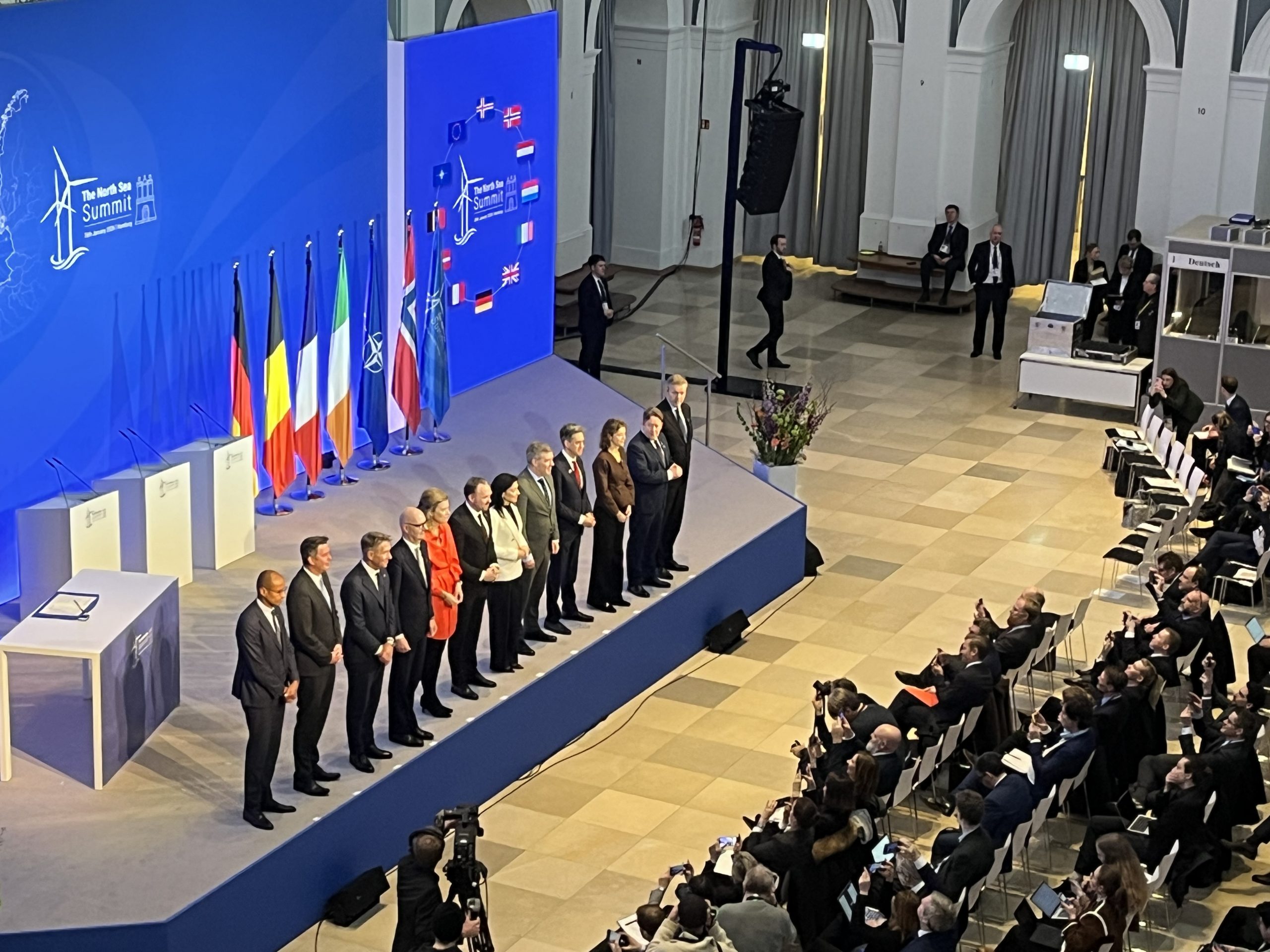
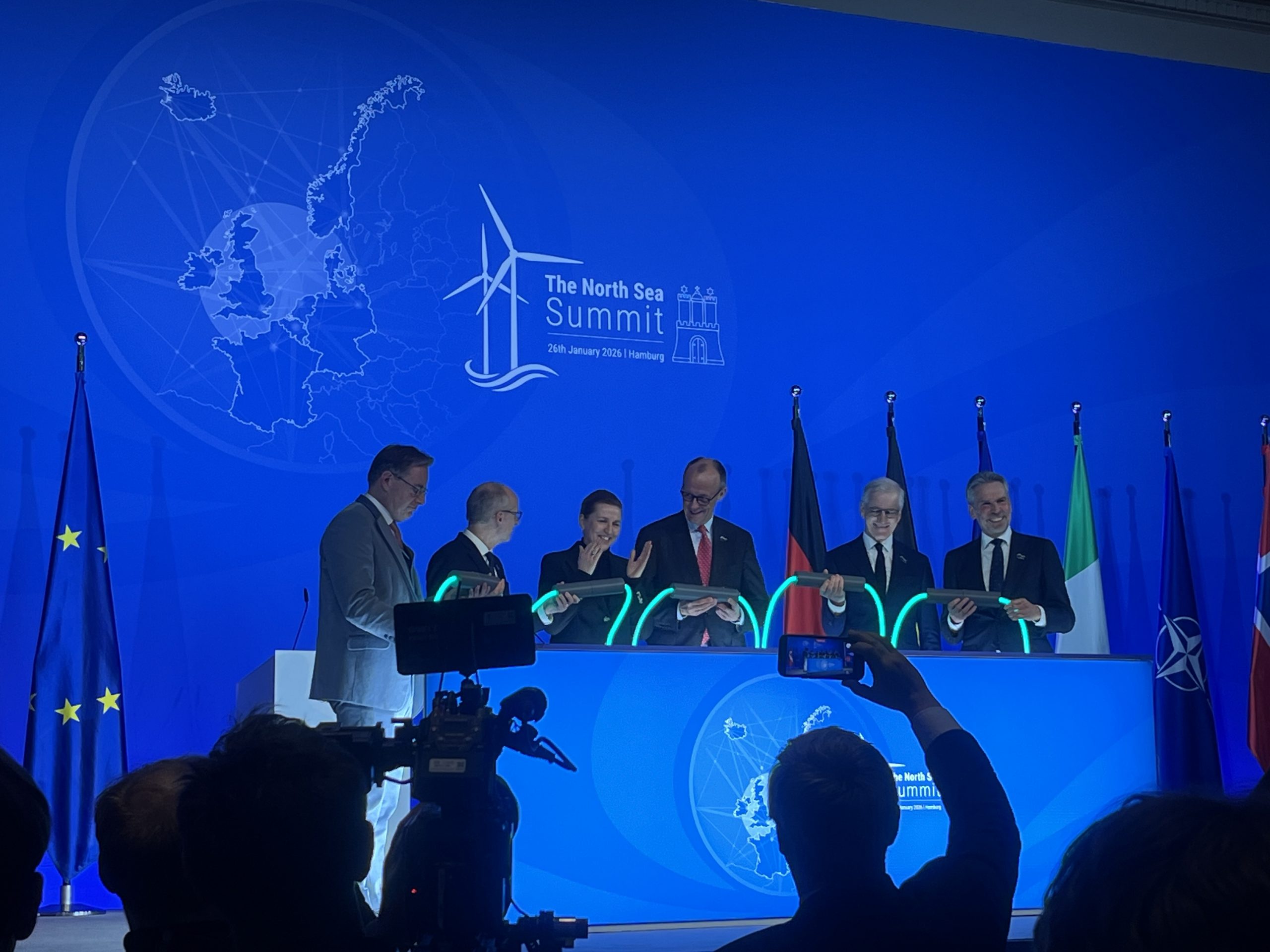
The North Sea Summit of the North Seas Energy Cooperation (NSEC) took place in Hamburg at the end of January 2026. Europe’s offshore wind potential is at the heart of efforts to achieve climate neutrality, affordability and energy independence in the midst of turbulent geopolitical conditions – Green Industrial Deal.
As part of the North Sea Energy Cooperation, NSEC energy ministers, the European Commission and stakeholders met last year to set the agenda for the next 15 years of cooperation. Building on the Esbjerg and Ostend declarations, the energy ministers of Belgium, Denmark, France, Germany, Ireland, Luxembourg, the Netherlands, Norway and the United Kingdom signed joint declarations in Hamburg setting out their targets of 300 gigawatts by 2050, tenders for European installation capacities of up to 15 gigawatts per year in the period 2031-2040, 100 gigawatts of cross-border cooperation projects for the North Sea and the work of the NSEC. Link: https://www.bundeswirtschaftsministerium.de/Redaktion/DE/Veranstaltungen/2026/20260126-nordsee-gipfel-2026-in-hamburg.html
The task now is to be able to work together on a fair competitive basis to ensure that these objectives, to which the North Sea countries and the industry have committed themselves, can be successfully achieved:
– 300 GW offshore wind capacity in the North Sea by 2050 (including 100 GW cross-border cooperation projects)
– 15 GW offshore wind energy per year in the period 2031-2040
– 91,000 additional jobs by 2030
– Harmonized and effective implementation of the Net Zero Industry Acts
– Cost reductions and risk mitigation for offshore wind power investments
– Investments of EUR 9.5 billion in supply chain capacities by 2030
– (…)
This is also an important development for an energy-intensive sector such as the European steel industry, both in terms of affordable green molecules and electrons and with regard to the EU market for the wind industry.
What was still missing for me: The Carbon Border Adjustment Mechanism (CBAM) climate protection instrument must be optimized in order to make foundation construction in Europe competitive. The electricity market design should be urgently adapted, also with regard to the necessary power purchase agreements, in order to enable energy-intensive industry to decarbonize. And last but not least: there must be a common EU-wide maritime strategy, otherwise major value creation potential will go to third countries and the necessary ships will not be available in time. By the way, port areas are not yet available for these goals, at least in Germany.
The reconstruction of the supplier industry for offshore wind power in Germany and the new development in some EU countries should under no circumstances be jeopardized by uncertainties such as discussions about expansion targets, decreasing grid connection capacity, etc. in order to avoid making offshore wind energy unnecessarily expensive. In any case, an important key is the development of independence from Europe when it comes to the availability of rare earths, for example.
There is still a lot to be done, even if the EU pulls together. In this context, it was irritating to suddenly hear offshore wind referred to as a transitional technology in Hamburg. Nevertheless, I am convinced that the EU, together with the UK, can and must secure a high proportion of the value creation potential for Europe in order to avoid further loss of competitiveness and to counteract deindustrialization.