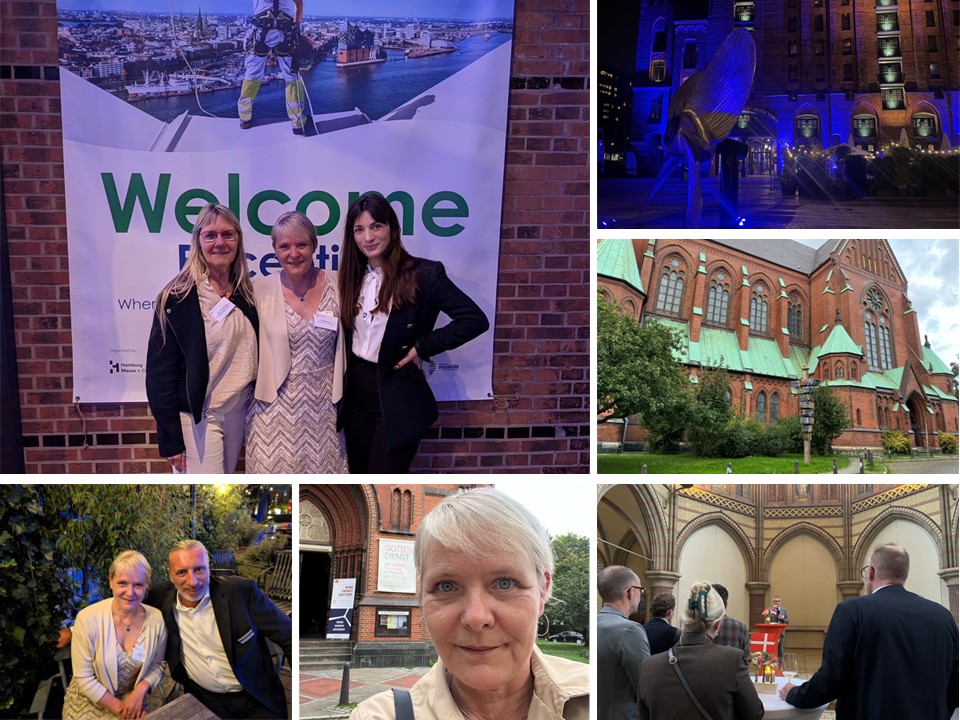
My post-trade-show hangover is slowly fading, and everyday life is returning to normal. What remains are the many thoughts, questions, and ideas that WindEnergy Hamburg brought with it—or rather, sparked within me.
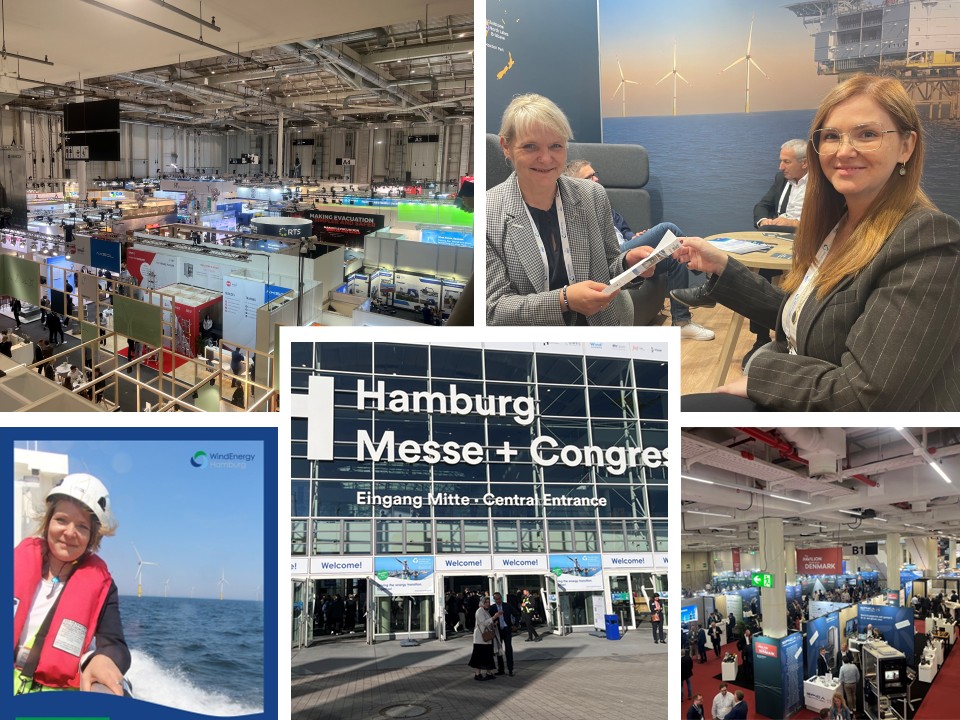
From September 22 to 25, the onshore and offshore wind industry reaffirmed its commitment to transformation. More than 40,000 attendees from over 100 countries visited the Hamburg Messe und Congress venue, and more than 1,600 exhibiting companies from around 40 countries showcased their offerings in Hamburg. Among them were a large number of companies from the offshore wind industry, with a growing proportion of companies based outside Europe.
On the one hand, the mood was exceptionally good due to the opportunity to reconnect with one another; on the other hand, it was somewhat subdued and, in some respects, pessimistic, largely due to the ongoing regulatory discussions at the EU and national levels.
First, the positive news: It is truly gratifying and impressive to see how well the offshore wind value chain has established itself. It’s remarkable how closely the players in Europe are already networked and how much expertise and innovation have been developed. Despite all the challenges, Europe has a strong offshore wind value chain.
On a less positive note: Currently, 16 gigawatts of expansion capacity are up in the air in Germany alone. The implementation of these projects in the German North Sea and Baltic Sea is highly relevant for many companies. Simply withdrawing a project can significantly delay the contract award process. Where is implementation falling short? This question is crucial for the continued growth of the European offshore wind value chain.
With the new Windenergie-auf-See-Act, the originally set expansion target of approximately 20 gigawatts is now in question and is to be offset by international projects. Spatial planning is also a key factor in this case, just as it is with the 16 GW. There are too few full-load hours and too few areas with the necessary full-load hours to meet the operational capabilities of offshore wind power. Is it really a lack of space, or is it a planning shortfall, whereby offshore wind energy—which is in the public interest—is being sidelined in favor of other utilization interests?
The debate over PPAs and CfDs—whereby even index-linked CfDs are now being called for, which may indeed be more realistic for financing given the current electricity market. But where does the problem lie, in view of electrification? A sustainable energy supply system requires the estimated 70 gigawatts of offshore wind energy in Germany—both from the perspective of a stable power grid and, in any case, with regard to the production of green hydrogen.
PPAs, for example, are indispensable for the necessary lead market of steel for offshore wind and, as is clearly evident from the recently inaugurated He Dreiht offshore wind farm, are currently in high demand. Steel for transformers has just secured additional safeguards at the EU level. Steel for foundations, however, remains significantly underprotected (ETS / CBAM) against unfair competition from outside Europe. Or is it really the case that only the “local content” model in Poland is capable of creating a stable market?
It seems to me that the number of exhibitors from outside Europe has increased significantly at this year’s WindEnergy. Envision Energy from China, for example, unveiled a 16+ MW model designed for the European market. Dajin is supplying TPs for the Gennaker nearshore Baltic Sea wind farm (approx. 1 GW). At the same time, the EU is continuing to work on strengthening industrial resilience within the European Union through the Industrial Accelerator Act (IAA) and the Net Zero Industry Act. Investments by the supply industry are already very high today and are severely jeopardized by the lack of a level playing field.
At WindEnergy, DNV led and presented the JIP (Joint Industry Project) together with eight companies from across the European offshore wind supply chain to address rising project costs, inconsistent auction results, and stalled development projects. “Industrialization and Standardization in North Sea Offshore Wind” highlighted the significant potential for cost reduction if the EU value chain maintains stable capacity utilization.
And this brings us back to the 16 gigawatts currently up in the air, awarded in 2022 and 2023. The supply chain cannot wait for new tenders to be issued. Solutions must be found for this. Furthermore, I find it hard to imagine that these sites—given the expected capacity factor and the sometimes unclear availability of a grid connection—would quickly find a new developer. Clarifying coordination seems more obvious to me here. Oh, and standardization does not mean a pause in development or freezing proven 15 MW platforms. Incidentally, it also means cybersecurity and advancing industrialization, as well as accelerating electrification. The further development of offshore wind energy will also proceed with cost efficiency. Cost efficiency does not mean reducing grid connections, unless they are offset by pipelines.
And if these 16 gigawatts can be built in Europe, we’ll definitely need the HUSUM WIND trade show platform next fall. In addition to the Windwanderer Festival and other maritime highlights, a two-day Offshore Wind Forum is planned. Several offshore wind companies have already expressed interest in exhibiting. I’ve already visited quite a few offshore wind companies with the HUSUM WIND team. We were warmly welcomed, and the trade show isn’t just an onshore wind fair—it’s a national, European wind fair: anchored in Husum.
In addition, conference formats will be necessary to make progress in the German offshore wind market, particularly with regard to the lead market of steel offshore wind.
In my opinion, from the perspective of the German offshore wind industry, the future of the offshore wind industry lies in Europe—in order to secure and expand this technology of the future; the European market is also necessary to ensure growth in jobs and value creation for onshore wind energy in general. Onshore wind energy in Germany is also currently facing major challenges with the new EEG and Grid Package. This was made clear by the protest organized by IG Metall Küste and Aktion Wind against planned cuts to wind power expansion. The silver lining in both regulatory developments is the resilience tenders, which are aimed at strengthening European value creation.
If the Federal Minister of Economics already recognized during the inauguration of Borkum Riffgrund 3 during trade fair week that an OWF sustainably delivers the output of a conventional power plant—and does so on an industrial scale—and represents an important factor for industry, then the expansion of offshore wind power should not be hindered by a lack of dialogue with key companies or by the currently still weak amendment to the WindSeeG. Business alliances are also calling for green hydrogen to be made available across the EU, including through domestic production. This is essential for a stable, sustainable energy supply system and cannot be achieved solely through excessive flexibility costs.
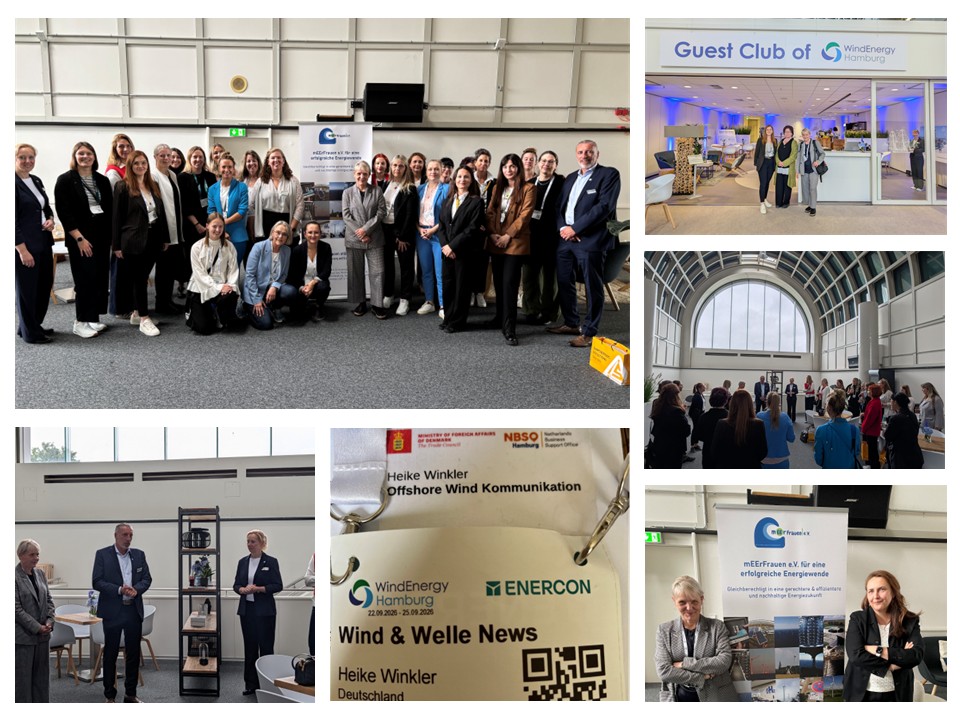
One indication of the wind industry’s value chain—which remains strong today—is the numerous women’s networks that have emerged and that welcomed all women in the wind industry in their own way at WindEnergy 2026. We at mEErFrauen were very grateful that, with the support of Hamburg Messe und Congress WindEnergy, as well as Trade Fair Director Andreas Arnheim and Julia Glawe, we were able to invite women from the onshore and offshore wind industries to a joint mEErFrauen lunch at the Guest Club.
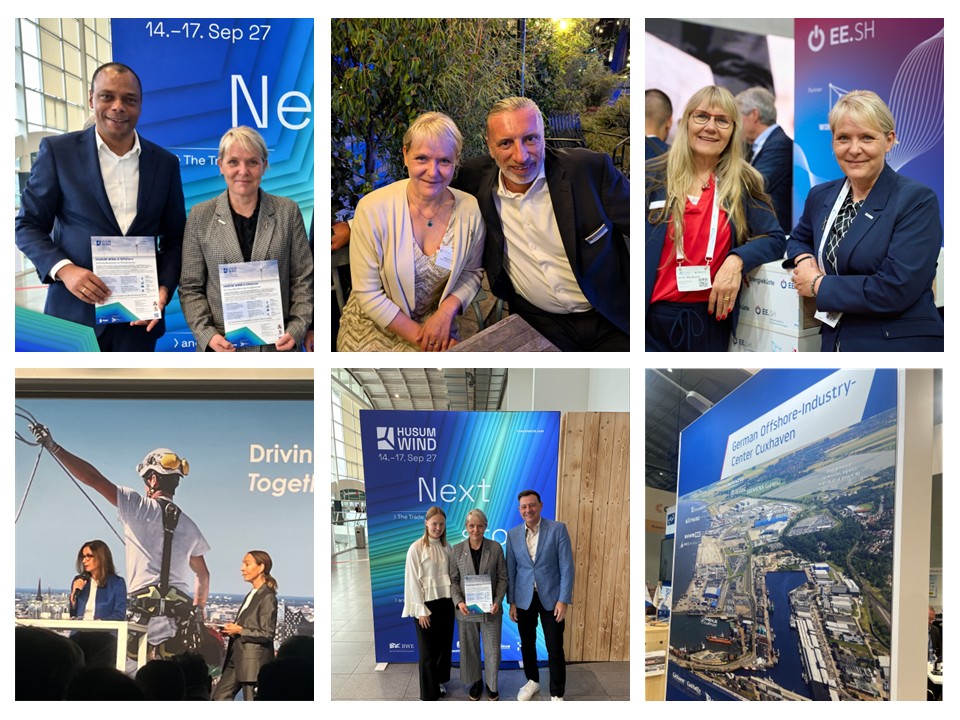
These are just a few thoughts for now on WindEnergy, the world’s leading trade fair, along with a look ahead to the next European wind energy trade fair in Germany.
With Wind & Welle News, we were happy to report on WindEnergy Hamburg for our Offshore Wind readers right from the scene.
I was thrilled to visit so many exciting companies during the trade show week and to meet so many old and new colleagues.
Moin Hamburg—Thank you very much, WindEnergy Hamburg—that was really fun!