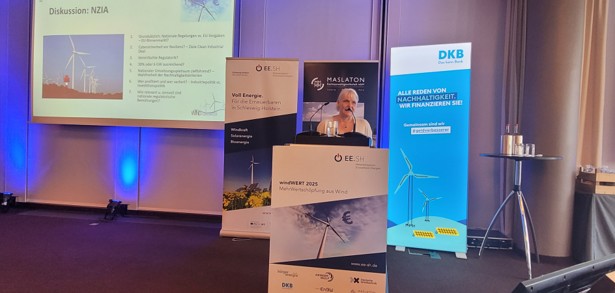
In early and mid-June, I had the opportunity to speak at enervis on the topics of resilience auctions and the Net Zero Industry Act. I had previously given a presentation on this topic at windWERT in Kiel in 2025, focusing on qualitative NZIA tender criteria.
The Wind Energy and Photovoltaics Platform (WPP) for municipal utilities and energy suppliers, and the Energy Industry Platform for project developers (EPP), the focus was on the regulatory framework within a European context and, of course, the connections to the planned resilience auctions under the proposed EEG (3.5 GW of onshore wind and 0.5 GW of PV). The resilience auctions are also under discussion in the context of the 🌊⚓ Offshore Wind Act (2 GW). Since it makes sense to use EU regulatory developments as a benchmark (which is to be expected; keyword: notification), it is important to examine the possible tender conditions.
Put simply, resilience tender requirements have so far been known under the umbrella term “sustainability criteria” and have already been implemented in this form on a smaller scale in European countries as well as in the context of the WindSeeG in Germany.
With its current offshore wind tenders (fixed and floating), France has adopted the NZIA criteria. Compliance with these criteria and the imposition of penalties were also addressed in the most recent tender.
- What specific requirements do resilience-focused calls for proposals entail?
- Why should the German wind and solar industry address the issue of resilience tenders?
- Which prequalification and/or award criteria are mandatory, and which are more optional?
- How can compliance with these criteria be monitored and, for example, penalized?
- And perhaps to start with, why do we need these criteria in the calls for proposals for onshore and offshore wind and, to a limited extent, for PV, given that there is hardly any industrial production left in Europe in these areas?
First, some background:
Clean Industrial Deal
Europe’s industrial base is of central importance to our identity and is indispensable to our competitiveness.
Without a strong industrial sector, there can be no resilient economy.
However, Europe is grappling with rising geopolitical tensions, slow economic growth, and technological competition.
In this new era, it is clear that a strategy for competitiveness and decarbonization is also a matter of security. The EU must address three challenges—the climate crisis and its consequences, concerns about competitiveness, and economic resilience—immediately and simultaneously.
As highlighted in the Draghi Report and the Competitiveness Compass, a decarbonization strategy that is well integrated into industrial, competition, economic, and trade policies is a powerful driver of growth.
Clean Industrial Deal, Net Zero Industry Act
Unless Europe significantly expands its production capacity or rethinks the way supply constraints are factored into its auction framework, and does not also reconsider them in light of existing non-European distortions of competition, the post-2030 targets will not be achieved at the pace and at the cost required by the energy transition; this is particularly true given the current geopolitical situation.
At this turning point for European industry, the Clean Industry Deal aims to open a new chapter in European industrial history, one marked by growth, resilience, and a leading role on the world stage.
The Green Deal:
- Green Deal Industrial Plan
- REPower EU
- The Recovery and Resilience Facility
Based on four complementary pillars:
- A predictable and streamlined regulatory environment
- Faster Access to Funding
- Enhanced Competence
- Free Trade for Resilient Supply Chains
The Industrial Plan under the Green Deal is intended to simplify, accelerate, and coordinate incentives in order to maintain the EU’s competitiveness and attractiveness as an investment destination for industry and manufacturing, taking all fundamental factors into account.
To reduce energy costs in the EU, we must accelerate electrification and the transition to clean, EU-generated energy, complete our internal energy market through physical interconnections, and use energy more efficiently. We must succeed in creating a true Energy Union that benefits everyone. This is precisely why an action plan for affordable energy is being adopted.
The Action Plan for Affordable Energy outlines measures to reduce energy costs. These include, in particular, the increased use of (cross-border) Power Purchase Agreements (PPAs) and Contracts for Difference (CfDs).
The “Clean Industry Deal” integrates climate protection and competitiveness into a comprehensive growth strategy. It represents a commitment to accelerating decarbonization, reindustrialization, and innovation simultaneously across the entire continent, thereby also strengthening Europe’s resilience.
CfD – PPA
The focus is primarily on two closely related sectors. First, energy-intensive industries , which urgently need support for decarbonization and electrification.
Second, in the sector of sustainable technologies, which plays a central role in future competitiveness and is essential for industrial transformation, the circular economy, and decarbonization.
The Clean Industry Deal aims to make the EU a global leader in the circular economy by 2030.
On February 26, 2025, the European Commission adopted the “Clean Industry Deal: A Joint Roadmap for Competitiveness and Decarbonization.”
These three initiatives, among others, are intended to implement this framework:
- Net Zero Industry Act ( The EU Net Zero Industry Act (NZIA) entered into force on June 29, 2024)
- Critical Raw Materials Act aka Critical Raw Materials Act
- Reform of the electricity market
Net Zero Industry Act (NZIA, Regulation on Net-Zero Technologies, Regulation 2024/1735) — By 2030, the EU should be able to meet at least 40% of its annual demand for net-zero technologies domestically. This will make the EU’s 2030 climate and energy targets and its 2050 climate neutrality target more achievable.
NZIA Measures:
- Strategic Projects
- Less bureaucracy and faster approval
- Support for carbon capture and storage projects, particularly through the development of additional storage sites.
- Investment Incentives
- Improved market access: Applying sustainability and resilience criteria in public procurement processes and auctions to stimulate demand for renewable energy.
- Innovations
- Development of Skills
Germany is behind schedule in implementing this!
The implementing law has been in effect since October 2025
The scope of the NZIA includes all “projects for the production of net-zero technologies”
This includes planned commercial facilities or the expansion or rezoning of existing facilities for the purpose of producing the following net-zero technologies (Article 3, No. 16 of the NZIA), e.g.:
- Solar technologies, including photovoltaic, thermoelectric, and thermal solar technologies,
- Technologies for onshore wind power and renewable offshore wind energy,
- Battery and Energy Storage Technologies
The current requirement is that qualitative bidding criteria apply to at least 30 percent of the volume auctioned annually in each EU country , or 6 gigawatts.
Cross-Sectoral Net Zero Industry Act:
- Offer Net-Zero Academies and training and continuing education programs for careers in net-zero technologies
- Governance and Oversight
- Innovation & Regulatory Sandboxes
- Net-Zero Europe Platform (Net-Zero Regulatory Burden Scientific Advisory)
- Acceleration Valleys (Net-Zero Acceleration Valleys)
When it comes to components used for “resilience assessment,” using onshore wind energy as an example, a distinction is made between:
Primarily used onshore wind components (Delegated Act), which form the basis for:
Key Specific Onshore Wind Components (Implementing Act)
Mandatory prequalification criteria:
- Responsible Business Practices
- Cybersecurity (see NIS2 Directive)
- Ability to deliver projects completely and on time
Prequalification or award criteria must be included to assess the auction’s contribution to sustainability and resilience (Article 26, 2024/1735) – Example: Evidence of compliance with the resilience requirement through customs documents or other relevant documentation proving the origin or place of assembly of the net-zero technology or its key specific components, including invoices or other means
Public contracting authorities and, when awarding public contracts, must apply mandatory minimum requirements for environmental sustainability and mandatory requirements for assessing the tender’s contribution to resilience (Article 25, 2024/1735)
The choice of the type of criteria for the auction’s contribution to sustainability and resilience (prequalification or award criteria) falls under the the authority of the agencies responsible for the auction.
The following applies to onshore and offshore wind and electrolysers: Resilience assessment even with at least 40% dependence on a third country, with reference to China (projected production exceeds domestic targets as well as foreseeable demand)
Award or prequalification criterion
The auction’s contribution to sustainability can be assessed by incorporating criteria related to environmental sustainability, innovation, or integration into the energy system . The Commission is granted implementing powers to establish the minimum requirements.
- CO2 footprint measured on a life-cycle basis
- Recyclability
- Biodiversity
- Energy Efficiency
- Water Management
- Environmental pollution
- Innovation (Innovation Auction)
- Energy System Integration
On December 31, 2027, and every two years thereafter, the Commission is to conduct an assessment of the sustainability and resilience criteria.
There are European manufacturers and production capacities in the onshore and offshore wind sectors. Without long-term utilization of production lines, China’s market power in Europe will increase.
The continuous expansion and establishment of production lines by European manufacturers over a period of at least five to seven years are essential. The development of supply chains for critical raw materials and production lines, as well as incentive and investment protection measures, must be consistent with climate protection goals and plans for expanding renewable energy.
On June 25, 2025, the Commission adopted the State Aid Framework under the “Clean Industrial Deal” (“CISAF”), which implements the objectives set forth in the “Clean Industrial Deal” (“CID”) in the area of state aid.
CISAF builds on the experience gained with the Temporary Crisis and Transition Framework (TCTF), which it replaced.
CISAF is currently in effect through the end of 2030, which allows for a longer planning horizon and creates stable conditions for investment.
To date, there have been no resilience auctions or NZIA criteria in Germany.
The CISAF federal regulation is not a funding program in its own right, but rather a framework under state aid law. In Germany, initial funding is provided through the Joint Task “Improvement of the Regional Economic Structure” (GRW) and the STARK program for coal-mining regions. Additional funding opportunities are being explored.
I don’t want to go into detail here about the strategic projects or “valleys.” The first Net Zero Valley in Germany is Lusatia. Others will follow, and here, too, the key question is to what extent the European ideal will actually be used as a benchmark.
The Commission published the draft legislation for the “Industrial Accelerator Act” (IAA) on March 4, 2026. The goal is to strengthen the EU’s competitiveness and industrial resilience in the face of global challenges. The IAA aims to increase the share of industrial manufacturing in the EU’s GDP to 20% by 2035 (up from 14.3% in 2024).
Among the most important sectors covered by the law are energy-intensive industries, net-zero technologies, and the automotive industry.
The proposal calls for the following measures:
- “Made in the EU” and Low-Carbon Preferences in Public Procurement and Public Funding
- Strengthening Foreign Direct Investment (FDI)
- Industrial Growth Areas
- Streamlined permitting procedures for industrial manufacturing projects.
The IAA is consistent with the Net Zero Industry Act (NZIA) and complements it (target: end of 2026).
The proposal is in line with the European Climate Act and with recent initiatives to streamline approval procedures and strengthen the competitiveness of the automotive sector.
The proposal is consistent with other EU legislation aimed at supporting the transformation of European industry toward a clean, circular, and climate-neutral economy.
In the steel sector, the upcoming delegated act on steel products under the Regulation on the Ecodesign of Sustainable Products (ESPR) will provide the necessary elements for implementing the lead market provisions for steel.
The IAA establishes the framework for the procurement of “Made in Europe” products, covering energy-intensive industrial products, net-zero technologies, and automotive components.
This approach ensures consistency and legal certainty for both contracting authorities and economic operators.
Proposals from the European Commission to the IAA for improving the NZIA:
- 8 gigawatts of tender volume as a resilience auction, or 40%—instead of 6 GW, or 30%
- Cybersecurity for 100% of the auctioned volume.
- Criteria may be waived in the event of a 20% increase in costs (instead of the 15% specified in the NZIA) or significant delays exceeding seven months.
- At least one major component—or (three years after the law takes effect) two components—must come from Europe.
Here, a clear trend can be seen in the evolution of NZIA toward the IAA. The focus is shifting toward industrial production in Europe; the goal is not short-term cost efficiency—which is highly valued here in Germany—but rather medium- to long-term European economic growth.
The following can be said about the renewable energy value chains:
The volumes in the resilience auctions may be too small to have the desired effect.
For PV, the proportion of components sourced from third countries is too high to realistically apply resilience criteria to production; therefore, the benchmark is initially assembly.
For the onshore wind supply chain, the resilience tender represents a real opportunity to regain market share in Europe and in export markets.
For parts of the supply chain with values below 1,000 MA, the resilience requirement can entail significantly more work; depending on the supplier-customer relationship, it seems sensible to me to consider how to “price in” the additional effort.
Cybersecurity and resilience entail additional bureaucratic burdens, which, in my view, are more than justified by the goal at hand: nothing less than the opportunity for economic growth, greater security, and European sovereignty!
The pros and cons of resilience auctions certainly need to be analyzed in greater depth. However, this can also be done while resilience tenders are underway. Waiting for draft legislation….
With a more ambitious EU electrification target, the measures described can be further accelerated. Since updates are made on an ongoing basis, some details may have changed again by the time this is published—I ask for your understanding. If you are interested, I would be happy to provide the sources.